 Pen
In this section…
Key Practitioner’s Skills, Engaging with Parents/Carers and Families, Graduated Response Process, One Page Profile, Observation, Planning and Demonstrating Progress.
In this section…
Key Practitioner’s Skills, Engaging with Parents/Carers and Families, Graduated Response Process, One Page Profile, Observation, Planning and Demonstrating Progress.
SEND assessment in the Early Years requires practitioners to have key skills. Accessible training is imperative to enable Early Years practitioners to understand and develop the range of skills needed to undertake SEND assessments.
Clear guidance is offered in the Statutory Framework for the EYFS concerning partnership working with parents and carers. Practitioners should always start with the information a parent is able to offer about their child. Respecting parents’ knowledge about their own child and what they currently do at home is vital to support their children’s learning. Practitioners need to invest in establishing relationships with parents and carers, building trust to allow families to tell their own stories in their own time.
Parents should be seen as the most important source of information and should continue to be actively involved in any Plan, Do, Review cycle.
This recommendation reflects the guidance offered within the Statutory Framework for the EYFS and nowhere is this more clearly demonstrated than in the following four principles:
(p5/6 Statutory Framework for the EYFS March 2014)
Statutory Framework for the Early Years Foundation Stage
https://www.gov.uk/early-years-foundation-stage
SEND code of practice: 0 to 25 years
https://www.gov.uk/government/publications/send-code-of-practice-0-to-25


Where concerns arise these should be addressed through the Graduated Response process. It is anticipated that this process will allow parents/carers to share their insights of their own child. Practitioners need to understand the purpose of the Plan, Do, Review cycle within the context of the Graduated Response. They need to recognise that the Graduated Response does not begin when outside agencies are drawn in but far earlier when the setting begins to explore different strategies and possible styles of support.
Council for Disabled Children – SEND and Disability in the Early Years Toolkit (24th June 2015)

This co-constructed document places the child at the centre and offers a unique image of them. The voices of the child and parent should be clear and apparent. The richest profiles are written in a positive and celebratory style, free from professional jargon. The One Page Profile will evolve overtime as the child changes and develops. In this way, each updated One Page Profile offers another tool for celebrating the child’s development and progress. At times of transition the One Page Profile plays a vital role in ensuring important information is shared.
In the Early Years, the One Page Profile can often involve the adult transposing their thoughts and knowledge of the child. For the parents and carers this is intimate knowledge and must be apparent.
The Working Party anticipates that practitioners will use detailed observations to gain an understanding of what the child is already
To achieve this, they anticipate that practitioners will use a range of frameworks such as the afore-mentioned
This formative assessment will allow the practitioner to plan for possible development. The Statutory Framework for the EYFS states that
“Assessment plays an important part in helping parents, carers and practitioners to recognise children’s progress, understand their needs, and to plan activities and support. On-going assessment (also known as formative assessment) is an integral part of the learning and development process. It involves practitioners observing children to understand their level of achievement, interests and learning styles, and to then shape learning experiences for each child reflecting those observations”
(p.22 ‘Statutory Framework for the EYFS’ March 2014).
Prime and Specific areas of the EYFS;
Statutory Framework for the Early Years Foundation Stage
https://www.gov.uk/early-years-foundation-stage
The seven aspects of cognition and learning;
The Rochford Review: Final Report
https://www.gov.uk/government/uploads/system/uploads/attachment_data/file/561411/Rochford_Review_Report_v5_PFDA.pdf
The Te Whariki questions;
Te Whariki Early Childhood Curriculum
https://education.govt.nz/assets/Documents/Early-Childhood/Te-Whariki-Early-Childhood-Curriculum.pdf
The Working Party’s one page profile questions;
The Early Years Developmental Journal;
https://councilfordisabledchildren.org.uk/sites/default/files/field/attachemnt/merged-early-years-developmental-journal.pdf
The Characteristics of Effective Learning.
https://www.early-education.org.uk/download-development-matters-early-years-foundation-stage-eyfs


From the image of the child’s current learning and development the practitioner will be able to identify what the child enjoys. The most powerful assessments come from shared reflection and consideration of the observations made. From these, practitioners will be able to identify what the child is interested in and willing to engage with, to inform their planning process. Practitioners’ interpretation of their observations will be informed by their understanding and knowledge of a child’s identified SEND and individual needs. The quality and rigour of the observations allows the practitioner to engage in a dialogue with other professionals, who are then able to share their own knowledge and insight.
1.6. Practitioners must consider the individual needs, interests, and stage of development of each child in their care, and must use this information to plan a challenging and enjoyable experience for each child in all of the areas of learning and development
(p.8 Statutory Framework for the EYFS March 2014).
Through reflection the practitioner is enabled to consider ‘Possible Lines Of Direction’ (PLOD) not only in terms of the development of skills but also in terms of the experiences that can be offered. From what is observed, it is possible to consider what can be done to engage the child more deeply.
Rather than teaching skills, practitioners need to acknowledge that children are intrinsically motivated to learn, and are curious about their environment. In doing this the practitioner is able to deepen and extend the child’s experience by introducing enjoyable and meaningful challenges. These opportunities should in time lead to the child extending and developing their knowledge.
Generally there is a misunderstanding that practitioners should plan for linear developmental progression. However the Working Party considers it important that practitioners focus on the consolidation and assimilation of a skill, exploration or interest to support children’s development and learning.
Te Whariki Early Childhood Curriculum
https://education.govt.nz/assets/Documents/Early-Childhood/Te-Whariki-Early-Childhood-Curriculum.pdf
The Early Years Developmental Journal;
https://councilfordisabledchildren.org.uk/sites/default/files/field/attachemnt/merged-early-years-developmental-journal.pdf
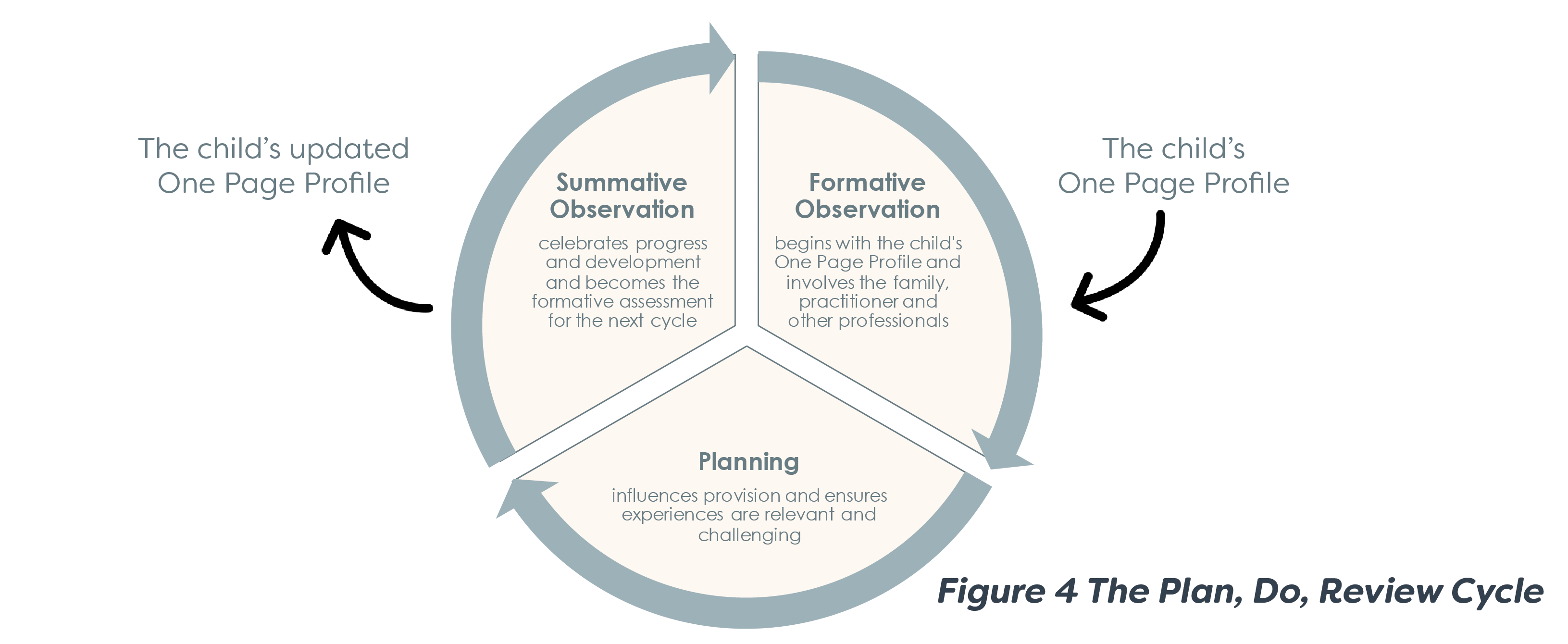
A child’s progress will be demonstrated when practitioners engage in the cycle outlined below. The child’s ‘One Page Profile’ and the summative observations made at the end of each cycle can be supported by video, photographs and written observations as evidence. This documentation will celebrate the child’s development, engagement and learning style and where appropriate will in general sit alongside the child’s tracking of progress through the EYFS.
However, the Working Party was aware that for particular groups of children it will not be possible to demonstrate progress through the age bands of the EYFS. In this case, the Working Party anticipates that external agencies will accept and celebrate along with Early Years practitioners the progress demonstrated using the Plan, Do, Review cycle, see Figure 4 below.
The non-statutory guidance offered in the Development Matters in the EYFS states that;
‘Children develop at their own rates, and in their own ways. The development statements and their order should not be taken as necessary steps for individual children. They should not be used as checklists. The age/stage bands overlap because these are not fixed age boundaries but suggest a typical range of development’
(p.6 Non-Statutory Guidance Development Matters in the EYFS Early Education 2006).
Figure 4 The Plan, Do, Review Cycle
Non-Statutory Guidance Development Matters in the EYFS Early Education 2006
https://www.early-education.org.uk/download-development-matters-early-years-foundation-stage-eyfs