Assessing Young Children with SEND

On this page…

Pen Green Key Concepts (Theoretical frameworks for thinking about children’s learning and development), Observation styles and techniques (narrative, video), Assessment Profiles, Examples of Spikey Profiles, Progress Summary/Review Report, Assessment Pathways & Child’s Voice.

Key Concepts

Theoretical frameworks for thinking about children's learning and development

For many years, Ferre Laevers and his team, early childhood researchers from the Leuven Institute in Belgium, have been studying young children. Laevers is interested in what is going on for children when they are engaging in ‘deep level learning’. Rather than focusing on ‘outcomes’, he has been focusing on ‘process.’ The team have developed tools to help us identify deep level learning.

As well as thinking about the extent of each child’s involvement, Laevers and his team have been studying children’s emotional well-being. Laevers refers to ‘involvement and well-being’ as the two process variables that tell us how children are doing. He states that ‘By ‘well-being’ we mean ‘feeling at home’ or ‘being oneself’ and/or ‘feeling like a fish in water’. Having high well-being means expressing feelings appropriately, rather than always seeming happy.

Schemas are ‘patterns of action’ that children demonstrate when they are exploring the world and trying to find out how things work. Children usually try out the same action on a variety of different objects. They come up with their own working theories about how things work. They continue to test out their theories or ideas. Sometimes they discover exceptions to the rules that they have established with their working theories.

Observation styles and techniques

Family Workers observe children in many different ways mainly through narrative and snap-shot observations. We also use photographs and video recording to support our documentation of children’s development and learning.  We consider the observations of the child in the setting and those from home and then plan for the child following their interests.  We link the observations to the Early Years Foundation Stage and the relevant child development frameworks that we use. All of this detailed documentation helps us support and understand how the children develop and learn.

“When we observe, we are trying to understand what each child is trying to learn about, so that we can tune in to and support their cognitive and emotional concerns” (Arnold, 2010)

A narrative observation is a detailed account of children’s language, actions and emotions made in the moment.  Over time a set of narrative observations can demonstrate what motivates and interests each child, which in turn can help to plan for children’s learning and development.

Examples of narrative observations can be found in the case studies.

Assessment Profiles

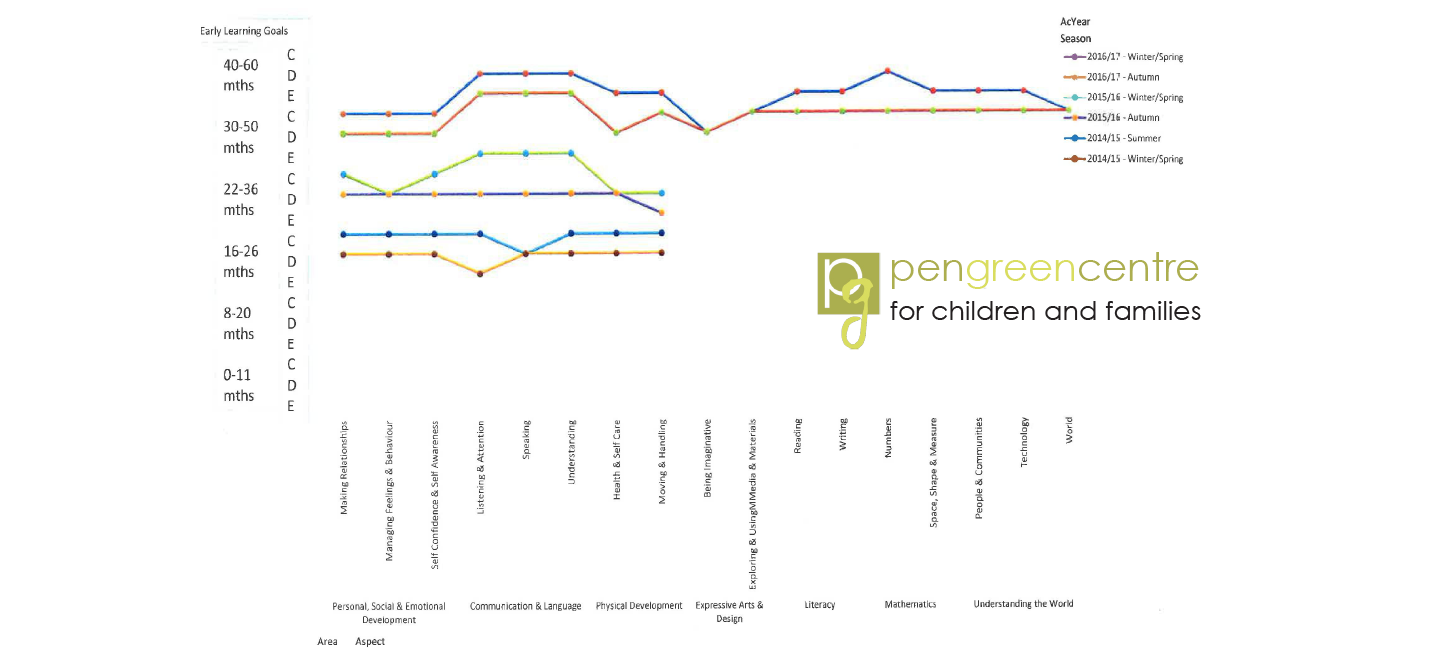
Children’s progress is monitored alongside parents using our Making Children’s Learning Visible (MCLV) assessment programme (validated by C4EO in December 2012). This assessment tool has been developed at Pen Green, using the EYFS. Three times a year (February, June, October) Family Workers assess children making a professional judgement of a child’s development and learning to be ‘emerging’, ‘developing’, or ‘confident’ within a particular age band for each aspect of learning – irrespective of their chronological age. These assessments are made collaboratively by both the parents and the worker. The Making Children’s Learning Visible software programme collates this data to produce a graph showing the child’s development over their time in the setting. This provides robust data which we use to track each child’s progress, identify areas of strength, areas for development, and any specific areas for concern. The initial assessment enables workers to plan pedagogical responses to meet the needs of each child including ways to engage their parents in their child’s learning. The MCLV programme allows for interventions to be put in place in response to assessment data while the children are still attending nursery. Cohort data and group data also gives information to help plan curriculum developments and priorities.

When we reflect on the outcomes for groups of children we always look at children with SEND. Following the analysis of the data we identify action plans to support individual and cohorts of children and regularly monitor the impact of the action plans.

Examples of Spikey Profiles

Progress Summary

This form is used to review and summarises a child’s progress over a period of time with reference to their progress against the EYFS. This report can be used for review meetings when a child’s special educational needs and disabilities are reflected upon.  Parents, practitioners and external agencies’ views are included in this review.  Next steps  and areas of development are planned this meeting and then reviewed at the next Progress Summary.

Child's Voice

We have developed a ‘Child’s Voice’ document that supports us in gathering the views of the child when attending Team-Around-the-Family meetings (TAF meetings). The Family Worker will complete the proforma adding comments to show how the worker is reflecting on the child’s experiences and taking the views of the child into account.

< Go Back to Parental Engagement                             Move on to Planning >