Pen
Pen
On this page…
Asking the right questions, Sharing Concerns with Families in Early Years Settings, Home Visits, Getting to know you, Dialogue with Parents, The Pen Green Loop & One Page Profiles
On this page…
Asking the right questions, Sharing Concerns with Families in Early Years Settings, Home Visits, Getting to know you, Dialogue with Parents, The Pen Green Loop & One Page Profiles
Knowing children well involves getting to know them in their home environment, which is why home visits are so important. For many workers their only point of contact is in the family’s home. Children remember a home visit for many months, if not years. Home visits can play a really important part in forging relationships with families and providing a space for parents to discuss a whole range of different issues in the safety of their own home.
The initial home visit to a family is the most important visit, as this is where the foundations of the relationship and trust with the child and their family begins. ‘What we want for all children is for them to be rich in potential, strong, powerful, competent and, most of all, connected to adults and children’. On a regular basis staff come together to think about their ‘image of a child’ and how they will support all children to be all that they can be.
On this first home visit, Family Workers use a proforma to gather information about the child.
Firstly the Family Worker gathers information about who lives in the house and their relationship to the child. We believe that this information is important, as these adults are the people who will be significant for the child and have an influence on the child’s life. What we have found is that many families have family names and words that have a special meaning for their children. The Family Worker would discuss with the parents whether they would like their family names and words to be used in the setting. For children to hear familiar words and the use of a family name can offer some reassurance when making the transition from home to the setting. For some children it is important to have visual images of the significant people in their life. With permission from parents the Family Worker would take some photographs or ask the parents to provide photographs which could be put into a book and shared with the child during their time in the setting. This simple resource gives the Family Worker a chance to talk with the child about the familiar people in their lives and is another way of offering a sense of reassurance and security.
Margaret Carr and colleagues have developed an evaluation framework for workers with five powerful questions from the child’s point of view which we use to get to know children when they start in our setting. These questions come from the five strands of the Te Whãriki curriculum. We have used them to enable workers to reflect on how they know, understand and relate to the children they are working with. We use these questions to help us document how we are responding to each child in their Celebration of Achievements file and share this with the key adults in their lives.
Any field of knowledge has its own language or jargon. A specialist language may be a barrier to communicating with parents. If we want power to be shared with parents, the first step is to share any specialised language we are using. We have been exchanging information with parents about ‘schemas’ or ‘patterns of behaviour’ for almost 30 years now. Parents usually pick up this technical language very quickly and apply it to what their own children are doing. Here is an example from a child’s online learning journal written by his mother illustrating her understanding of his ‘connecting’ schema:
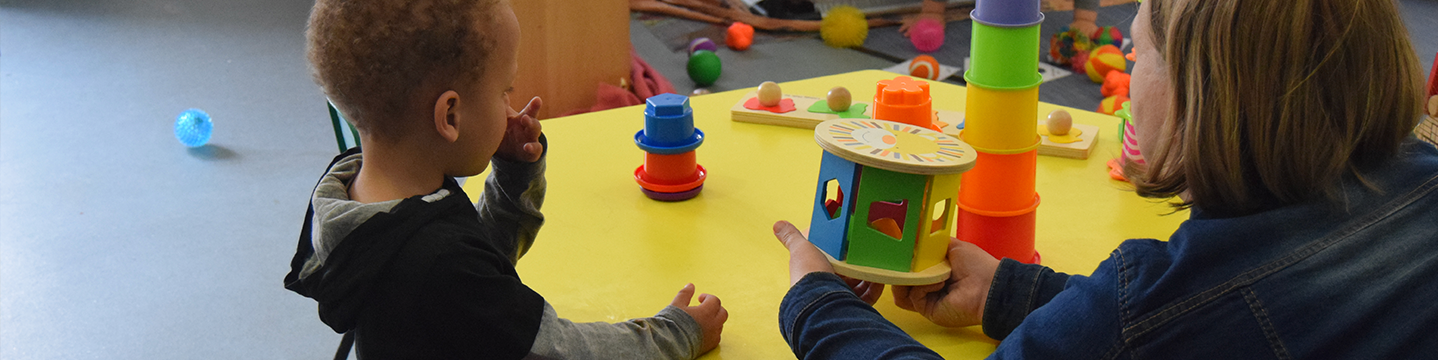
When we share this technical language with parents, we also share our knowledge about how their children learn. It gives us a clear focus. So, as workers, rather than just saying to a parent, ‘William has had a lovely time playing today’ (which, in fact, tells them very little about what William has actually been doing at nursery), we can say, ‘William really enjoyed building a vertical tower with hollow blocks today’ (a more specific statement about what William has actually been interested in).
We could choose to simplify our language, but parents might find that patronising. We can hardly claim a wish to be equal partners if we arbitrarily decide that the language is too difficult for parents to understand. Of course, we might explain that it was a ‘very tall tower’ and that William called it ‘Notre Dame’. Video or photos of what happened immediately or later that day could support the information sharing. As soon as we begin to share language about the curriculum, usually on the initial home visit, we are making our pedagogy more explicit. Each explanation we offer helps us to understand the concepts more fully.
Although the dialogue with parents begins with the initial home visit (before a child starts nursery) and continues throughout each child’s time at nursery, we do not expect parents just to pick up ideas in a haphazard way. We plan and devote time to giving every parent the opportunity to learn about the key child development concepts we are using in the nursery to help us understand their children’s learning. There are four concepts that we find particularly helpful:
Involvement
Well-being
Adult style and
Schemas
With a less stable nursery population, it is important for us to grasp every opportunity to talk with parents individually about their children’s learning and the concepts we use to understand their learning. Our first opportunity is on the initial home visit. A child’s Family Worker (key person) visits the family at home a few days before the child starts settling in to nursery. We plan for home visits to be relaxed, to be a time when parents can feel confident to ask us anything about nursery they are concerned about. We leave a ‘home visit pack’ with them as we realise offering a lot of information at once can be overwhelming. Within the pack is information on the four key child development concepts – involvement, well-being, adult style and schemas, as well as other information about our philosophy and practical issues.
Families usually stay in the environment of the nursery for two weeks from when their child starts attending nursery. This provides another opportunity to share with parents the four key child development concepts (involvement, well-being, adult style and schemas). We also set up ‘information sharing sessions’ each term, offering a morning, afternoon and evening session for parents to attend to learn more about theories for thinking about children’s learning).
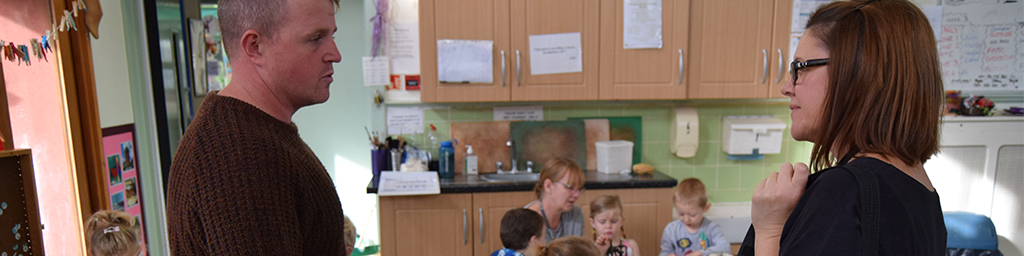
Informal conversation about what children have been engaged in that day either at home or nursery are another opportunity to share with parents on a daily basis. Obviously, we need to be aware of parents’ various work schedules but there is usually time for a brief chat at the beginning or end of the session or day. These times help us to connect with what children have been doing at home as well as informing parents about their child’s learning at nursery. Over time, the dialogue can become richer and deeper.
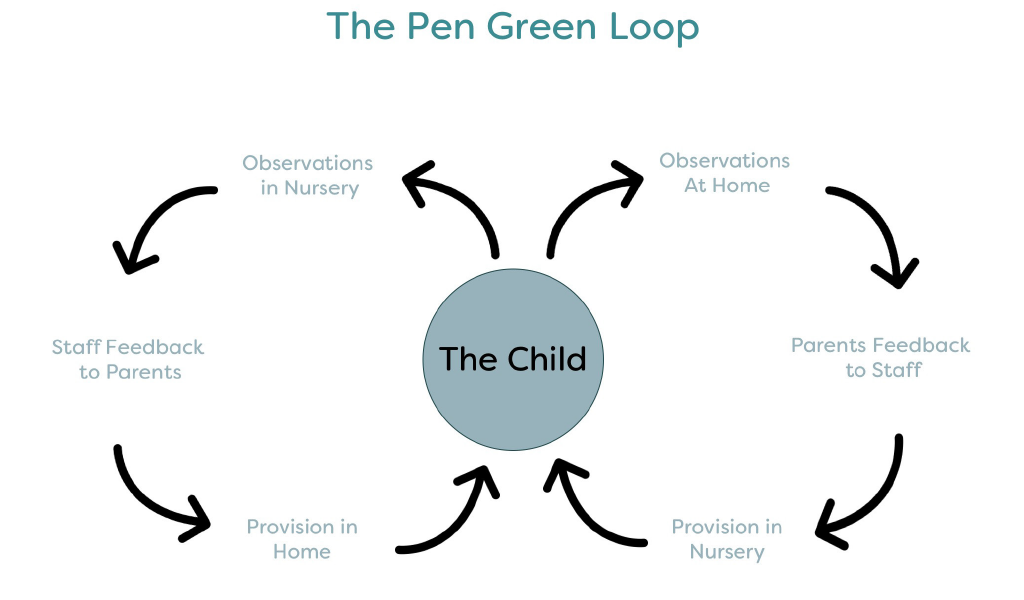
The online learning journal for each child is another opportunity to articulate our understanding of children’s learning using the language connected with their involvement, emotional well-being, schemas being explored and the style and strategies we adopt to support and extend their learning. When it works well, the online journal illustrates the ‘Pen Green Loop’ (page 68) and is a continuous two way dialogue with the child at the centre.
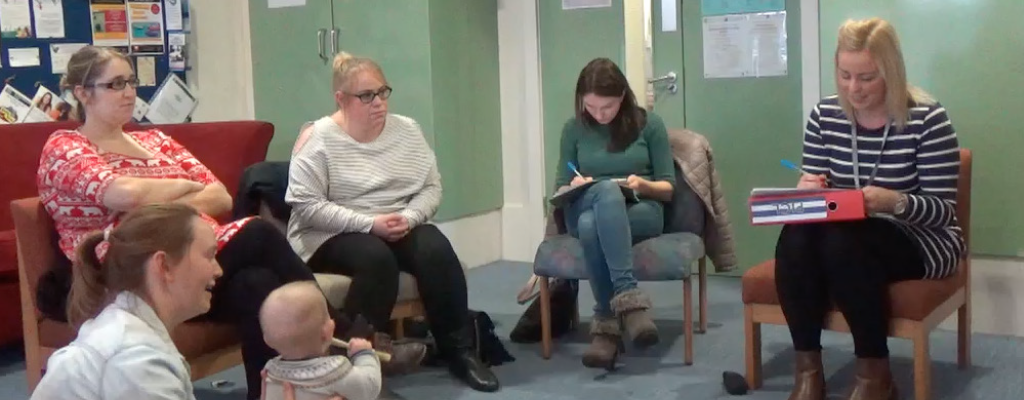
Following on from informally sharing ideas and running information-sharing sessions, we offer parents the opportunity to attend a weekly study group to engage in further dialogue about their children’s learning. We offer a morning, afternoon and evening group. Each group meets weekly and is open to all nursery parents though membership tends to be stable.
Although a great deal of our communication with parents is individual, we find that a group work model is very productive, when it comes to adult learning. Early childhood educators are in the unique position of coming into contact with children and their parents or carers daily. Because of this daily contact and a shared interest in the children, they are well placed to work with those adults as well as with their children. However, initial training, whether it is nursery nurse, social work, nursing or teacher training, does not usually prepare early educators for working with adults. Therefore, workers do need to undertake some groupwork training. This kind of training is offered to all staff at Pen Green.
Taken from Involving Parents in their Children’s Learning – a Knowledge-Sharing Approach (3rd Ed) by Margy Whalley and the Pen Green Team (2016)