 Pen
Pen
In this section…
Context, Introduction, Guiding Principles, Current Legislation and Frameworks, An Inclusive Assessment Process

In this section…
Context, Introduction, Guiding Principles, Current Legislation and Frameworks, An Inclusive Assessment Process
A small group of professionals was tasked with developing a celebratory assessment tool for children with special educational needs and/or disability. This work has been funded by the Department for Education.
The Children and Families Act (2014) states that;
‘A child or young person has special educational needs if he or she has a learning dificulty or disability which calls for special educational provision to be made for him or her’ (Part 3, Section 20 (1)).
A Working Party was drawn from a number of localities across the country; Corby, Haringey and Stockport and from a range of services and professional bodies. These have included: Early Years Teachers, Nursery School Head Teachers, Deputy Head Teacher from a Charity run SEND resource nursery school , Educational Psychologists from several local authorities, Lecturers in Special Needs and Early Years Education, Local Authority Early Years Leads for Inclusion, Special Educational Needs Co-ordinators, Representatives from National Portage Association, Head of an Integrated Centre.
All of those involved had a particular expertise or experience of working with children with additional and complex needs in the Early Years. As a group, they reflected on the assessment of children with SEND within Early Years settings. The group considered current initiatives, studies, documentation and assessment tools as well as statutory guidance and legislation.
There are a number of current initiatives within SEND and Early Years that we have also considered and which have influenced our considerations. These include the Rochford Review (2016), The Complex Learning Difficulties and Disability (CLDD) Research Project (2011), Te Whariki (1996, May 2017), Early Years Foundation Stage Curriculum (2014 updated 2017), Development Matters in the Early Years Foundation Stage (EYFS)(2017), SEND Code of Practice (2014 updated 2015), Laever’s work on Well Being and Involvement (1997, 2005), and Chris Athey’s work on schemas (2007).
A further development has been the government funded NASEN SEND Gateway which offers easy access to a range of materials for education professionals. The Working Party however were eager to explore materials that focussed solely on the Early Years seeking to support professionals working within the private and voluntary sector. The aim being to create an accessible and free online tool kit supported by video vignettes of practice and exemplars of documentation.
The Rochford Review identifies that
‘The government has high aspirations for every child and is clear about the importance of robust assessment in helping raise educational standards’.
The review also
‘recognises that age-related expectations are not appropriate for a significant proportion of pupils; and that the way we measure their progress accounts for potential differences in the way these pupils learn.’ (p.5)
Nationally the early years’ curriculum is guided by the Early Years Foundation Stage (EYFS) framework; settings use the Early Years Outcomes linked to the EYFS (Development Matters) as their assessment tool. However Early Years practitioners adopt a variety of methods to record children’s development and progress. As part of the ‘Building on Being 2’ DfE project facilitated by Pen Green, practitioners and parents were invited to join discussion groups. A key issue identified by practitioners was the difficulty they experienced in demonstrating progress for children with SEND using the Development Matters statements for children identified as having Special Educational Needs and/or Disability (SEND).


As a Working Party, we acknowledged that some children’s progress cannot easily be demonstrated or celebrated using the Development Matters statements. The Working Party identified some key challenges in relation to this:
The Early Years Outcomes are a non-statutory guidance in the form of statements that aim to offer practitioners a means of reviewing children’s progress. It is recommended that the Early Years Practitioner makes best fit judgements against broad and overlapping age bands across the seven areas of learning and development. Development and progress for children with SEND occurs but may not be linear (for example it occurs within a given age band) and often is not demonstrable within the Early Years Outcomes. This feature is also highlighted in recommendations made by the Rochford Review. In reference to setting expectations and measuring progress they identify that:
‘it is important that we are able to measure the progress they make in a way which takes into account the nature of progress for these pupils. Those with SEND can often make progress in different ways to the majority of pupils.’
(p.10-11)
For some children within the SEND population their developmental stages are significantly different from their mainstream peers and acknowledging this is vital. Seeking a norm referenced approach (e.g. EYFS) to assessment can lead professionals into adopting a deficit model what the child cannot do.
A different challenge comes from the spikey profile that some children present with; showing strength in some areas of development or in relation to some skills but not in others (see figure 1 below). Finding a means to demonstrate and celebrate this is important. Other children’s profiles will contain gaps because of the impact of their needs or disabilities (particularly in the area of Physical Development and Literacy).
Figure 1. Spikey Profile. This is a profile of a child with autism. This impacts on the child’s social interactions with peers and the development of communication skills. The child experiences difficulty in self-regulating emotions. Access to other learning opportunities are restricted by these factors.

Often the approach adopted is to identify small steps linked to teaching skills or completing a given task. This can lead to measurable outcomes but the Working Party wanted to explore a model that celebrated the whole child.
When considering some assessment tools there is a danger that we focus on the role of the adult rather than on the development of the child. Meeting support needs is important but cannot replace our observation and analysis of a child’s development.
Possible models have been explored and it is clear that what is needed is a toolkit that offers a range of possible avenues via which progress can be both celebrated and demonstrated. Such an approach will demand a higher skill base and must be underpinned by training, access to experienced staff and support from external agencies.
The SEND Code of Practice 2014 (most recently updated May 2015) identified 4 areas of need. Any assessment tool needs to allow consideration of all four areas.
Every child is entitled to access the EYFS curriculum or an equivalent and the Working Party feel strongly that the EYFS offers the practitioner a curriculum that supports learning and development for all children.
Early Years practitioners focus on development and learning within the Prime Areas of the EYFS:
Personal, Social and Emotional Development
Communication and Language
Physical development
The Prime Areas are the foundations that develop “….in response to relationships and experiences, and run through and support learning in all other areas. The Prime Areas continue to be fundamental throughout the EYFS” (p.4 Development Matters).
Practitioners also reflect on a child’s Characteristics of Effective Learning (p. 5-7 Development Matters).
Playing and Exploring (Engagement)
Active Learning (Motivation)
The Working Party recognises that celebrating the learning and development of children with SEND can present significant challenges to practitioners. The population of children with SEND within Early Years settings fall into 2 identifiable groups;
The Working Party has considered several assessment pathways with associated assessment tools. The aim being to place the child at the centre and to celebrate their learning and development. This is in line with The Characteristics of Effective Learning that celebrates the uniqueness of the child and “underpins learning and development across all areas and support the child to remain an effective and motivated learner” (p.4 Development Matters).
Figure 2 Possible Approaches to SEND Assessment in the Early Years
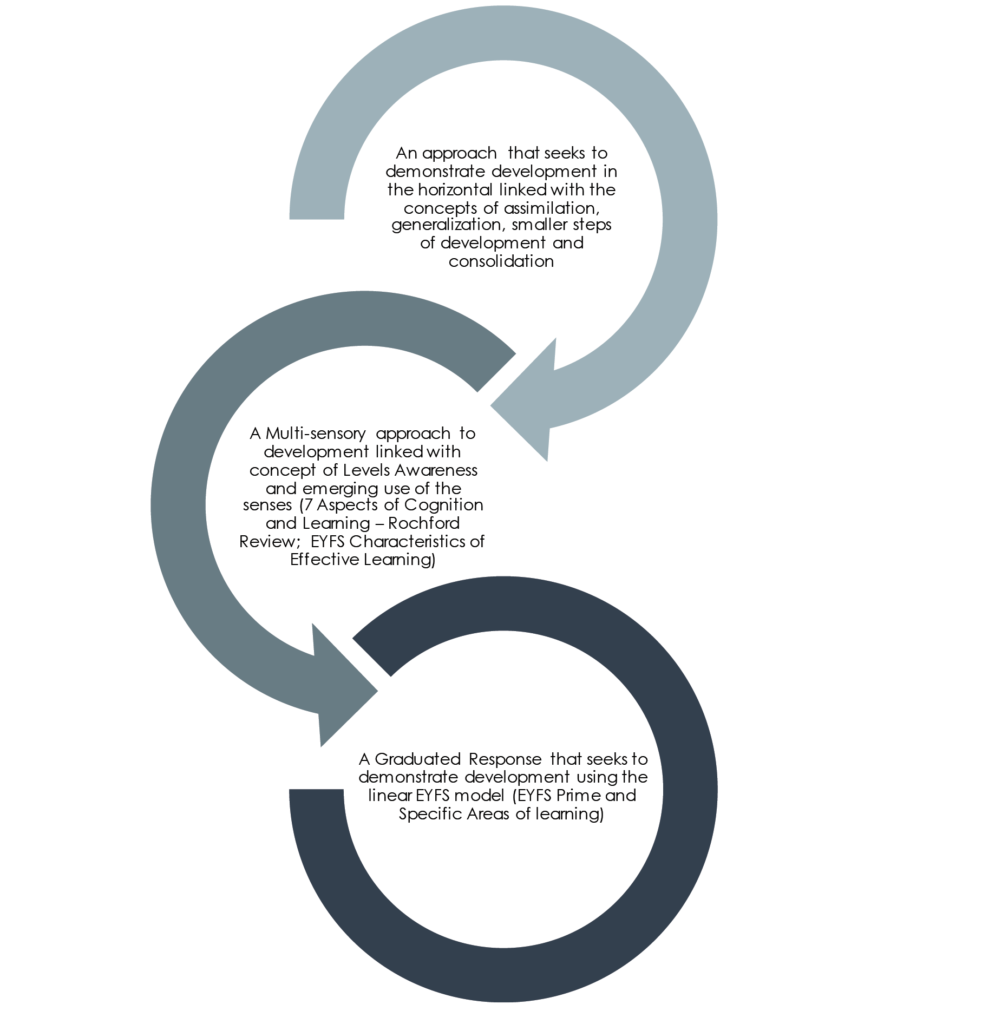
The Rochford Review recommends that for those children not engaged in subject specific learning, assessment should be made against 7 Aspects of Cognition and Learning;
Responsiveness
Curiosity
Discovery
Anticipation
Persistence
Initiation
Investigation
These are taken from recommendations made within the Engagement Profile and Scale developed as part of the Complex Learning Difficulties and Disability (CLDD) Research Project. The Working Party considered these aspects to offer a strong basis for observation and to be closely aligned to the Characteristics of Effective Learning.
It is vital that any proposals made must support all settings to have;
“high standards and high expectations for all pupils, so that every child achieves his or her potential regardless of background or starting point” (p.8 Rochford Review).
It is anticipated that these high expectations will be linked to clear concepts of ‘appropriate’ progress for individual children rather than a norm referenced measure that only succeeds in recognising delay. The aim cannot simply be to ‘narrow the gap’ since, as previously recognised, for some children ‘narrowing the gap’ and enabling a child to ‘catch up’ are not suitable expectations.
The Rochford Review also outlines the differences between formative and summative assessment and further considers the different purposes of statutory and non-statutory assessment (p.10). The Early Years Working Party have focused on ongoing formative assessment, seeking to inform practitioners as they plan for individual children. Providing a means “…to identify any gaps or misconceptions” and enabling them “…to plan the necessary steps towards learning for their pupils” (p.10).
The Working Party chose to focus on formative assessment in recognition of the short period of time that many children spend in their Early Years setting (when compared with their time within the compulsory education system).


Before considering the recommendations made by the Rochford Review the Working Party had spent some time exploring other approaches to assessment and observations. In particular, they considered the New Zealand Early Years curriculum Te Whariki (1996; May 2017); the Leuven Scales (1997; 2005) for Well-being and Involvement (Laevers) and Chris Athey’s work on Schematic Play (2007). Alongside these they also considered other approaches developed specifically for children with SEND. The three approaches offer different frameworks through which to consider a child’s play and development but all allow the practitioner to keep the child at the centre. They link closely to the 7 Aspects of Cognition & Learning. Figure 3 weaves together the threads of the EYFS and strands from Te Whariki to provide a complimentary assessment pathway.
Figure 3 – Assessment Pathways. Possible complimentary approaches to demonstrate progress in the Early Years (adapted from Te Whariki and EYFS)
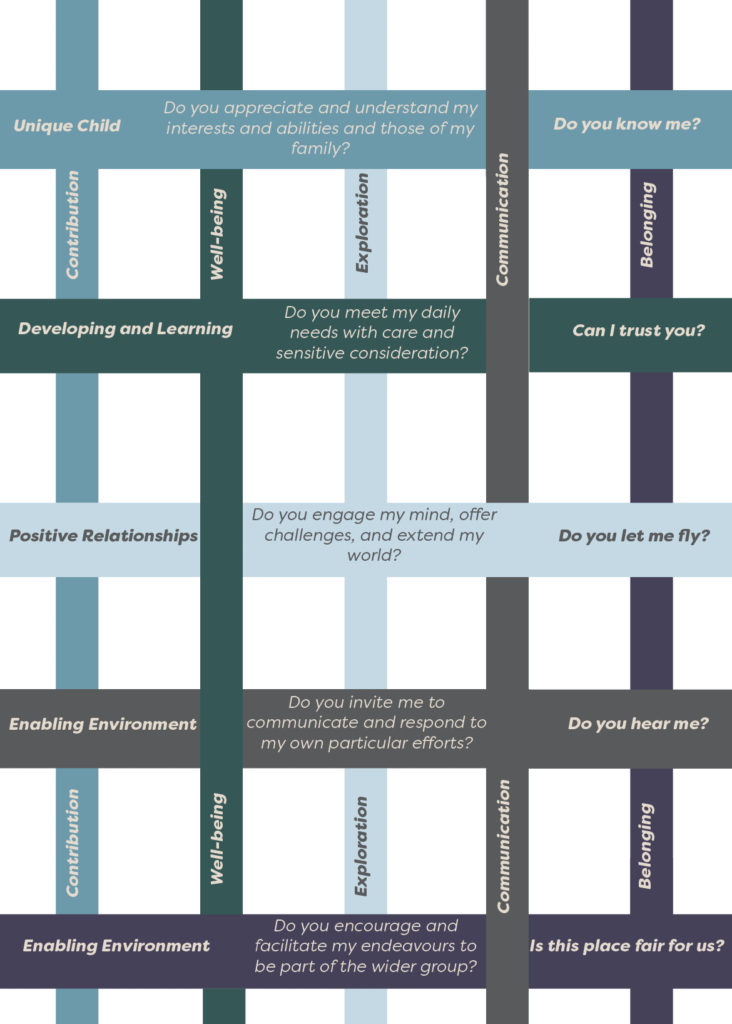
The Te Whariki model offers some key strands to consider when assessing a child in the form of five questions:
Do you know me? – linked with a sense of belonging
Can I trust you? – linked with well-being
Do you let me fly? – linked with exploration
Do you hear me? – linked with communication
Is this place fair for me? – linked with contribution.
Ferre Laevers developed a 5-point scale to measure a child’s well-being and involvement. The scale offers a means for the practitioner to assess the level of learning that is taking place. As the level of well-being and involvement is raised the learning increases. When a consistent high level of well-being and involvement is recorded, the practitioner can anticipate that a deep level of learning is taking place.
Athey defines schema as ‘patterns of behaviour and thinking in children’s play’; the EYFS refers to the powerful role of children’s schematic play in their development.
Athey defines schema as ‘patterns of behaviour and thinking in children’s play’; the EYFS refers to the powerful role of children’s schematic play in their development. Schemas are patterns of repeated actions and behaviours that can be observed in young children’s play as they explore and make sense of the world around them. Schemas are an intrinsic part of child development and offer an important insight into how some children learn. A knowledge of schemas offers practitioners a positive means of viewing and understanding a child’s actions and creating enabling environments for young children.
It was clear that any recommendations made with regards to assessment pathways should align with and complement other assessment tools and frameworks; and must link to recommendations being made by other working parties. The most pertinent reports were the Rochford Review and The Complex Learning Difficulties and Disabilities (CLDD) research project. Some boroughs have also sought to offer frameworks that expand on the Early Years Outcome statements identifying intermediate steps of development (for example Lancashire County Council’s EYFS progression Document; the North Somerset’s EYFS Support Assessment Statements for children with SEND and the Council for Disabled Children Early Years Developmental Journal). It is clear that professionals within early years and specialist provisions need to collate the positive work being done, allowing practitioners across a range of Early Years settings to access and use the tools being developed.
The 5th recommendation made by the Rochford Review (p.21) is that schools should be free to decide their own approach. In referring to this range of frameworks the Working Party are not seeking to dictate what a practitioner or setting does, but rather to offer a means of considering and reflecting on a child’s development and play. Settings may choose to adopt one or several frameworks. The purpose will always be to gather information that offers a picture of the child and which celebrates their uniqueness and skills.


