 Pen
Recognising Early Years Teachers: A welcome step, but is it enough?
The announcement of the £4,500 Early Years Teacher Recognition Payment is a welcome acknowledgement of the knowledge, expertise and professional commitment of those working to give young children the best possible start in life. It is an important signal that the expertise of the early years workforce matters. However, I feel that recognition must go beyond a one-off financial incentive.
For too long, early years education has experienced a disparity between the expectations placed on its professionals and the status, remuneration and career opportunities afforded to them. The Sutton Trust’s Early Years Workforce Review (Pascal, Bertram and Cole-Albäck, 2020), revisiting the recommendations of the Nutbrown Review, highlighted the continuing challenges of professionalisation, recruitment, retention and career progression in the sector. It argues for a highly qualified workforce supported by strong pedagogical leadership.
This matters because early years teaching is a specialist and complex professional endeavour. It requires deep knowledge of child development, curriculum understanding, an appreciation of how children learn through play and the ability to develop sensitive, responsive relationships. Bonetti and Blanden’s (2020) research Identifies positive associations between graduate-qualified staff, including those holding Early Years Teacher Status, and children’s educational outcomes. This reinforces the importance of professional expertise, particularly in addressing inequalities in children’s early learning experiences.
However, expertise cannot flourish in isolation. The concept of pedagogical leadership, alongside the development of professional learning communities, reminds us that teachers’ influence extends beyond their direct work with children. Yesterday the DFE also published new good practice guidance for Early Years Teachers and Settings which further recognises the breadth and complexity of the Early Years Teacher role. It explicitly identifies teachers as pedagogical leaders within their settings and communities, recognising that their contribution extends beyond direct work with children to include curriculum development, supporting colleagues and strengthening practice across teams. It also highlights the importance of ongoing professional development, working across the full early years age range, including babies, and engaging with families and communities. This is a significant step towards recognising Early Years Teachers as professionals who can influence and strengthen the quality of early education beyond their individual practice.
The recognition payment is therefore a positive step, but important questions remain. Eligibility restrictions based on geographical location and setting type mean that many equally qualified and committed professionals will not benefit, raising wider questions about equity and professional recognition across the sector. Furthermore, a one-off payment, while welcome, cannot address the structural inequalities in pay, status and professional opportunity that continue to affect the early years workforce. If the DfE is serious about recognising Early Years Teachers as pedagogical leaders, it must now move beyond financial recognition towards sustained investment in the profession. This means creating the conditions in which teachers have the time, support and access to high-quality professional development to fulfil their leadership role, develop the practice of others and strengthen the quality of early education. If we expect Early Years Teachers to lead pedagogy, develop colleagues, influence practice and improve children’s life chances, then we must invest in the professional conditions that enable them to do so.
At Pen Green Research, Training and Development Base we are passionate about investing in early childhood which means investing in the people who work with our youngest children. This requires sustained remuneration, meaningful career pathways, professional development and recognition of specialist pedagogical expertise across all settings. Our commitment at Pen Green is to contribute actively to this ambition through our comprehensive CPD offer, creating opportunities for practitioners, teachers and leaders to deepen their knowledge and strengthen their pedagogical practice. We believe that investing in professional learning is not an optional extra; it is fundamental to improving the quality of early education and outcomes of our youngest children.
Children deserve the very best and so does the workforce that supports them. Recognition that this DFE announcement brings is welcome but lasting professional investment is essential in the long term, and we still have a lot of work to go.
Thinking about your own professional journey?
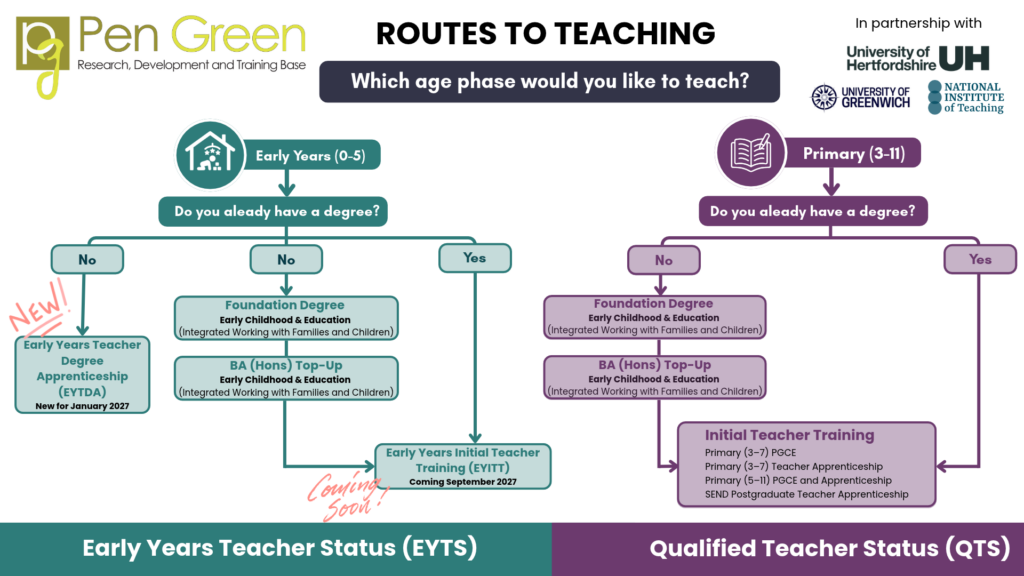
At Pen Green, we believe that investing in early years education means investing in the people who work with children.
Whether you are beginning your journey in early years, looking to develop your knowledge through a Foundation Degree or BA (Hons), or considering taking the next step into teaching, we offer a range of opportunities to support your professional development.
Our pathways include early childhood degree programmes, the Early Years Teacher Degree Apprenticeship (EYTS), and Primary (3–7) Initial Teacher Training leading to Qualified Teacher Status (QTS).
There isn’t one route into teaching, and everyone’s professional journey looks different. We’re here to help you explore your options and find the pathway that’s right for you.
Interested in taking the next step? Explore our courses and teacher training opportunities, or get in touch with our team for an informal conversation.
References
Bonetti, S. and Blanden, J. (2020). Early Years Workforce: Qualifications and Children’s Outcomes. Education Policy Institute, supported by the Nuffield Foundation.
Pascal, C., Bertram, T. and Cole-Albäck, A. (2020). Early Years Workforce Review: Revisiting the Nutbrown Review – Policy and Impact. Sutton Trust.
Department for Education (2026). Early Years Teacher Recognition Payment. Available at https://www.gov.uk/guidance/claim-an-early-years-teacher-recognition-payment
Department for Education (2026) Good Practice for Early Years Teachers and Settings. Available at https://www.gov.uk/government/publications/good-practice-for-early-years-teachers-and-settings/good-practice-for-early-years-teachers-and-settings